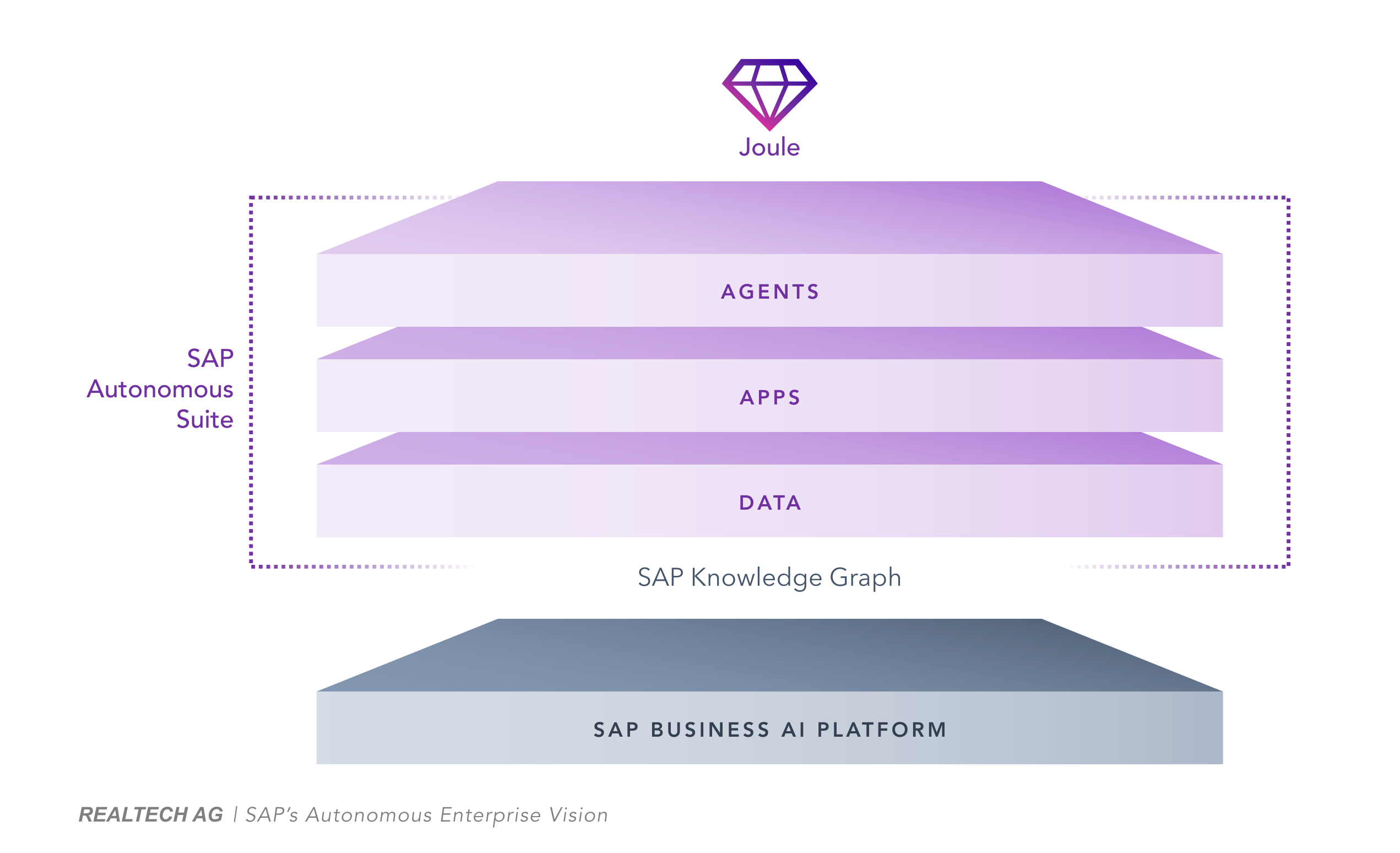
SAP Business AI bundles SAP’s AI portfolio, which is intended to make process AI productively usable in SAP applications: Joule as a copilot/orchestrator, embedded AI and AI services via SAP BTP. For IT, this primarily means clarifying architecture, authorization and governance issues so that AI in SAP can be controlled, audited and operated – regardless of whether systems run in the cloud, hybrid or on-premise.
From SAP Business AI to Autonomous Enterprise
SAP uses the term “Autonomous Enterprise” to describe the next stage in the evolution of business AI: AI is no longer intended merely to support individual tasks, but rather to increasingly guide, prepare, and – where appropriate and manageable – execute business processes in a context-based manner.
The focus is on AI agents based on SAP process knowledge, corporate data, and clear governance rules. SAP is integrating this development with the SAP Business AI Platform, Joule, Joule Studio, and new ways to embed agent-based AI into business processes.
For businesses, this means that business AI is becoming more strategic. It is no longer just about individual AI functions, but about determining which processes are suitable for AI-driven decision-making, automation, and assistance, and what conditions need to be put in place to make this possible.
Advantages, but realistic: where business AI helps
SAP teams are currently facing a real balancing act: cloud speed, rising expectations from the specialist departments (Joule & Co.) – and at the same time strict requirements for authorizations, auditing, operation and costs.
With Autonomous Enterprise, this balancing act becomes even more critical. AI is not only intended to streamline individual tasks but also to increasingly support end-to-end processes. This also raises the bar for quality, transparency, data access, approvals, and human oversight.
This is exactly where Business AI can help: not as “AI everywhere,” but as targeted support for typical bottlenecks in SAP operations and business processes – for example, when quickly categorizing documents or tickets, identifying exceptions, consolidating context from data, logs, and documentation, or preparing the next steps. With sound governance and the right architecture, the benefits become measurable and manageable.
AI in SAP: stumbling blocks & strategic questions
Before you go live with SAP Business AI, it’s worth doing a quick reality check: which AI scenarios fit your landscape? In SAP in particular, it is not so much the features that are decisive, but rather consumption (AI units), authorizations, operating model (cloud/hybrid/on-prem) and the question of whether you use embedded or extend side-by-side.
Why is SAP Business AI strategically important?
SAP Business AI is not an “add-on” that you activate on the side. It changes how SAP processes are managed and operated: AI is moving into the standard, making governance, cost control and architecture important management issues.
AI functions in SAP: typical use cases
When evaluating SAP Business AI, a simple filter helps: where is “invisible work” being created today? In other words, work that arises daily in SAP operations but hardly creates any value – searching, sorting, summarizing, matching, forwarding, clarifying queries. These steps are often the best place to start because they don’t change the core process, but save a lot of time. Here are typical use cases that many companies start with:
How SAP Business AI works on-premise
Many of SAP’s new AI features continue to be developed with a focus on the cloud. At the same time, SAP is increasingly making Business AI features available to existing customers with on-premise ECC or S/4HANA environments. For companies, this means that on-premise deployment is no longer a barrier to entry – though implementation typically occurs through hybrid architectures, SAP BTP, cloud services, and clearly defined integration models.
This is why a realistic architectural decision is particularly important in the context of the Autonomous Enterprise. Not every AI or agent scenario is implemented directly within the existing ERP core. Often, the most sensible approach is to start with SAP BTP, integration services, and controlled data access. This allows AI scenarios to be tested, expanded, and operated without unnecessarily altering the stable core of the ERP system.
SAP Business AI remains strongly cloud- and platform-oriented: features such as Joule, Joule Studio, AI agents, and generative AI scenarios are primarily delivered through SAP Cloud and BTP services. This does not exclude on-premise environments, but rather involves a different access and integration model.
Using SAP Business AI strategically – with REALTECH aiLAB
The REALTECH aiLAB is a practice and strategy room for SAP teams who want to realistically evaluate and advance business AI in a controlled manner. Together, we sharpen use cases, check feasibility and define the guidelines for productive use. The result: clear priorities, a resilient approach – including an initial prototype if required.