REALTECH aiLAB

SAP Clean Core: less complexity, more innovation

Many SAP landscapes have grown over the years and have become more difficult to maintain as a result. Individual customizations and technical dependencies slow down updates and innovations. SAP Clean Core helps to keep the core stable and to implement extensions in a controlled, maintainable and upgradeable way.

TL;DR – Key facts in brief

  • Definition: SAP Clean Core is an approach in which the standard core of an SAP system remains as unchanged as possible. Individual requirements are not implemented through direct modifications, but via defined enhancement mechanisms.
  • How this works: Companies are closely aligned with the SAP standard and use released APIs, on-stack extensibility or side-by-side models for extensions.
  • The advantage: Clean Core reduces technical debt, lowers upgrade risks and makes it easier to adopt new SAP functions and innovations more quickly.

What is SAP Clean Core?

SAP Clean Core is a strategy in which the standard core of an SAP system remains as unchanged as possible and individual requirements are implemented via defined, upgradeable mechanisms. This includes standardized processes, released APIs, modern extension models such as ABAP Cloud or side-by-side extensibility on the SAP Business Technology Platform (BTP) as well as clear rules for data, integration and operation.

For companies, this means above all: less technical debt, lower risks during upgrades and a more stable basis for SAP S/4HANA.

Work close to standard

Business processes should remain close to the SAP standard. This reduces complexity and facilitates subsequent changes.

Decoupling extensions

Individual requirements are implemented via released extension points, APIs or side-by-side models.

Ensure upgradeability

The cleaner the SAP core remains, the lower the risk for updates, releases and the introduction of new functions.

Why is Clean Core becoming so important in SAP projects?

Clean Core is not an abstract architecture theory, but a pragmatic answer to the typical problems of grown SAP landscapes. In many companies, individual custom code, special logic and dependencies that are difficult to understand have accumulated over the years. This is exactly where Clean Core comes in.

Historically grown custom code

Many SAP systems contain enhancements that have grown over the years and are difficult to maintain today.

Undocumented changes

A lack of transparency makes risk analyses difficult and even minor changes costly.

Higher upgrade risk

The more the core has been changed, the more complex and error-prone updates and release changes become.

More pressure to innovate

Companies want to use new SAP functions more quickly without having to secure existing special logic each time.

Advantages: What SAP Clean Core brings in concrete terms

Clean Core not only ensures “more order”, but also reduces very specific technical and operational risks. The approach makes SAP landscapes more maintainable, more transparent and more innovative.

Lower-risk upgrades

Less direct intervention in the core means fewer conflicts during updates.

Less technical debt

Historical special developments can be systematically reduced.

Faster innovation

New SAP functions, cloud services and modern development approaches can be used more quickly.

More governance and transparency

Architectural decisions become clearer and easier to control.

The five guiding principles of SAP Clean Core

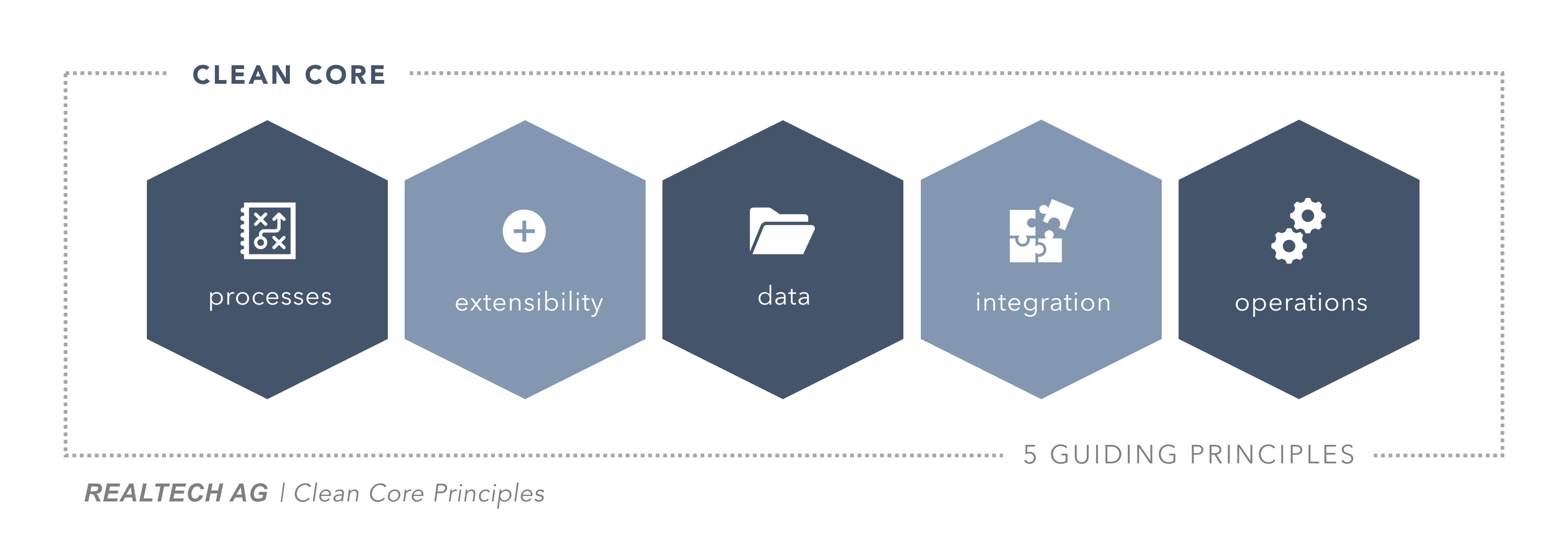
SAP categorizes Clean Core into five central fields of action: processes, expandability, data, integration and operation.

  • Processes: Business processes should be implemented as closely as possible to the SAP standard. Enhancements only make sense where they are really necessary from a business perspective.
  • Extensibility: Individual requirements should not be developed directly in the core, but implemented via released APIs, key user extensibility or the SAP BTP.
  • Data: A clean core also needs clean data structures. Standard fields should be preferred and custom fields should only be added using the mechanisms provided.
  • Integration: Interfaces should be implemented using SAP-compliant technologies and suitable integration platforms to ensure stability and future-proofing.
  • Operation: The operating model must also be geared towards maintainability and upgradeability with clear rules for changes, transports and governance.

Clean Core does not exclude customizing

A common misconception is that Clean Core excludes individual requirements. In fact, customizing remains important, but must be implemented in a structured, controlled and stable manner. Three typical models have become established in practice.

On-Stack Extensibility

Extensions directly in the SAP system – via ABAP Cloud, released APIs and key user extensibility. Cleanly integrated and implemented close to the standard.

Side-by-side extensibility

Stand-alone applications on SAP BTP that are connected to the SAP core via APIs. Ideal for individual logic without directly changing the standard.

Hybrid extensions

Many companies combine both approaches depending on the use case and target image. This results in flexible extensions with a clear separation from the SAP core.

How clean is your SAP landscape? The clean core level model

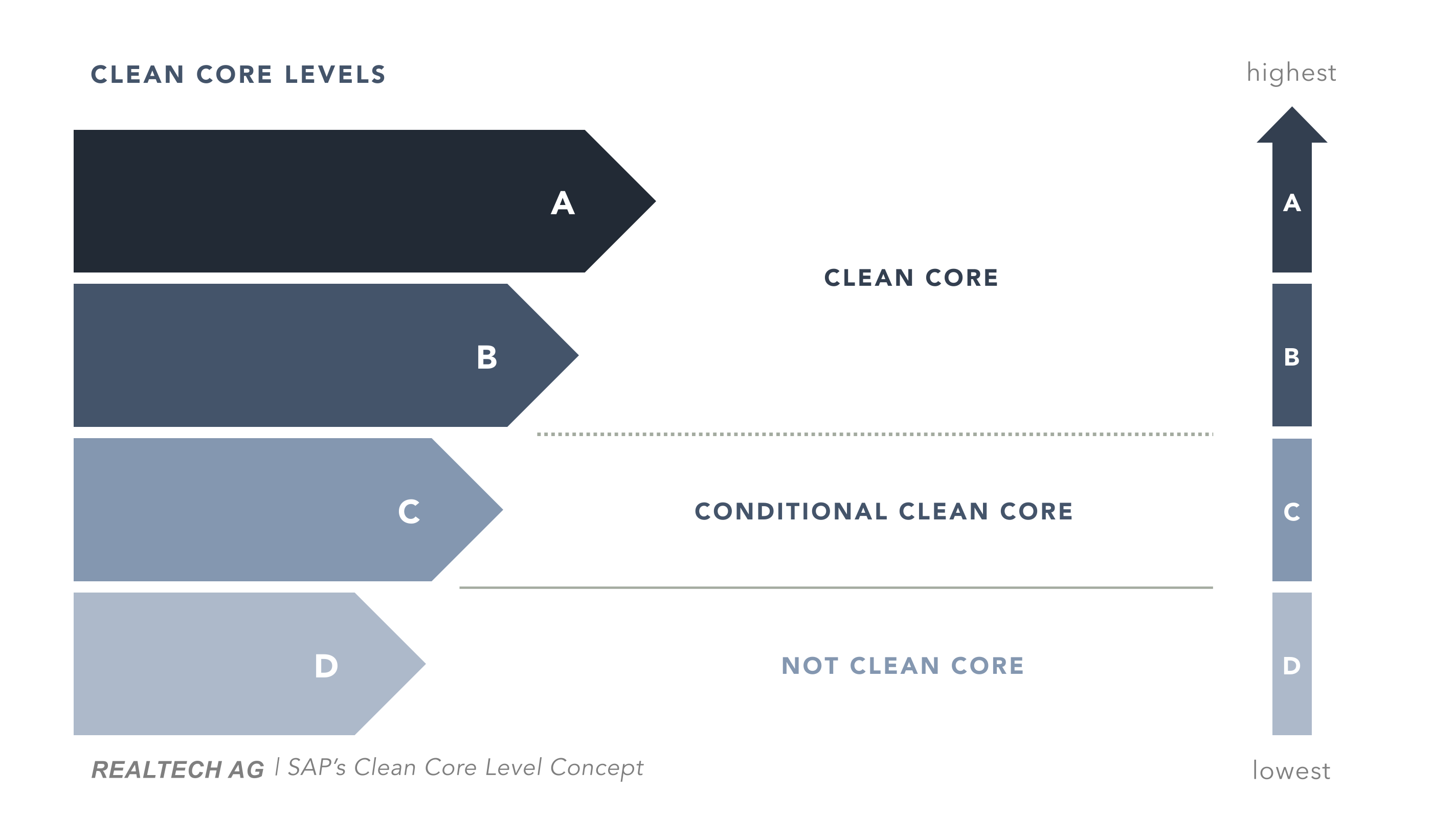
The real challenge often lies not in the strategy itself, but in the evaluation of existing and new extensions. SAP’s Clean Core Maturity Model helps to classify enhancements according to architectural quality, upgradeability and Clean Core compliance.

This reveals which extensions are already fit for the future, where risks exist and where modernization is required.

  • Level A (fully Clean Core compliant): Extensions with stable, published interfaces, for example with ABAP Cloud or BTP.
  • Level B (largely stable): Use of officially documented APIs that tend to be upgrade-stable.
  • Level C (observe critically): Adependencies on internal objects that may be acceptable for transitional phases but are not future-proof in the long term.
  • Level D (modernize): Modifications, direct table accesses or implicit enhancements with a high upgrade risk.

Implement Clean Core: Stay Clean and Get Clean

A realistic clean-core approach always has two sides: Existing legacy issues must be gradually reduced, while new requirements are implemented from the outset in a standardized and upgradeable manner.

Stay Clean

New requirements are implemented from the outset in such a way that no new technical debts are incurred.

Get Clean

Existing extensions are analyzed, prioritized and gradually modernized.

What does Clean Core mean for S/4HANA and BTP?

With SAP S/4HANA, Clean Core goes from being an architectural principle to a practical requirement. The more companies rely on standardized processes, cloud services and continuous innovation, the more problematic traditional modifications to the SAP core become.

In short: in the S/4HANA context, Clean Core not only means fewer modifications, but also a new operating model for extensions: closer to the standard, more decoupled and easier to control.

BTP is gaining in importance

Individual applications and extensions are increasingly being implemented outside the SAP core on SAP BTP. This keeps S/4HANA cleaner and easier to maintain.

ABAP Cloud becomes more important

New developments should be upgradeable and implemented close to the standard. ABAP Cloud and released APIs are therefore becoming more important than traditional modifications.

Delivery processes are becoming more critical

Clean core only works with clear rules for development, release and transports. This requires clean processes and transparency, especially in hybrid landscapes.

FAQs: SAP Clean Core

SAP Clean Core describes an architectural approach in which the SAP standard core remains as free as possible from direct modifications. Individual requirements are implemented via approved interfaces, ABAP Cloud or SAP BTP – upgradeable and maintainable.

No. Clean Core does not mean dispensing with individual requirements, but rather a structured implementation via planned extension models – on-stack, side-by-side or hybrid approaches.

On-stack extensibility uses ABAP Cloud and releases APIs directly in the SAP system. Side-by-side extensibility relies on independent applications on SAP BTP that communicate with the core via APIs.

Clean Core simplifies upgrades, reduces technical debt and keeps SAP S/4HANA maintainable and innovative in the long term. Standard and enhancements remain clearly separated so that core processes remain more stable.

SAP BTP is primarily the platform for side-by-side extensions. Individual applications and automations run outside the ERP core and are connected via API. This keeps the SAP standard clean.

Further topics

SAP BTP at a glance

The most important BTP modules for integration, side-by-side and AI in SAP – compactly explained.

REALTECH aiLAB

Prioritize use cases, clarify feasibility, set guidelines – in a practical way in the aiLAB.

SAP Business AI

Get started with SAP Business AI – exploring use cases, benefits, and practical first steps.

Create your AI Strategy

From AI ambitions to a clear, realistic roadmap.