REALTECH aiLAB

SAP Business AI: Joule, use cases & launch plan

SAP Business AI brings AI into SAP processes – from embedded functions to the copilot Joule. The decisive factor is the translation into your reality: governance, data, operation, costs (AI units) and architecture (SAP BTP & side-by-side). This guide gives you orientation, shows typical SAP Business AI use cases and the next realistic step.

TL;DR – Key facts in brief

  • Definition: SAP Business AI is the way SAP brings AI into the workflow - from Joule as an assistant to AI functions that support decisions and process steps directly in SAP.
  • Where teams start: side-by-side prototyping on the SAP BTP is a common way to get started.
  • Cloud-first, but hybrid: many AI services run close to the cloud, while the ERP remains stable on-prem. BTP creates a side-by-side model that enables innovation without touching the SAP core.
  • Why aiLAB: in the REALTECH aiLAB, possibilities become a plan: prioritize use cases, check feasibility in your landscape and define guard rails - as a basis for piloting and scaling.

What is SAP Business AI?

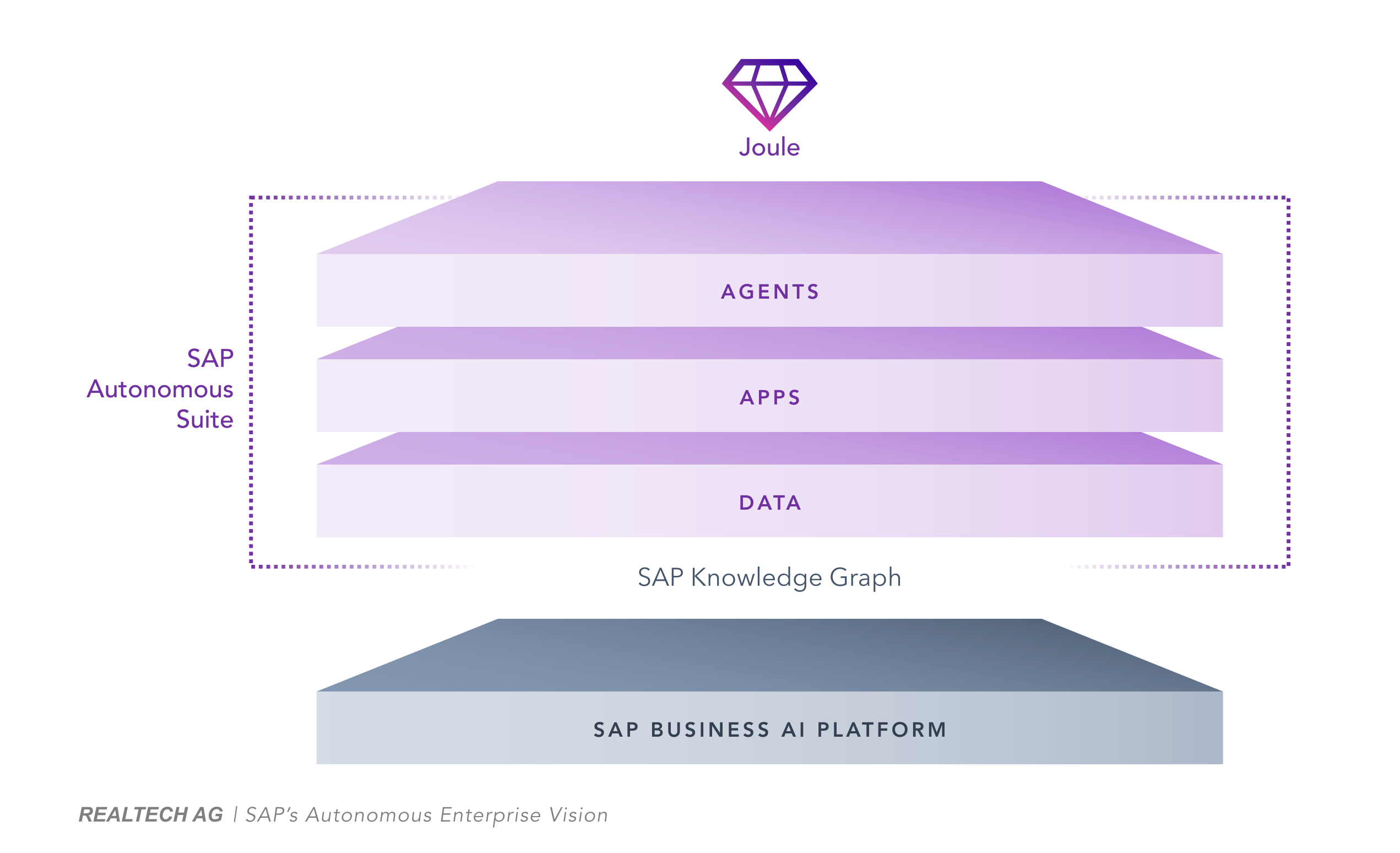
SAP Business AI bundles SAP’s AI portfolio, which is intended to make process AI productively usable in SAP applications: Joule as a copilot/orchestrator, embedded AI and AI services via SAP BTP. For IT, this primarily means clarifying architecture, authorization and governance issues so that AI in SAP can be controlled, audited and operated – regardless of whether systems run in the cloud, hybrid or on-premise.

SAP Joule

The generative AI copilot from SAP, integrated into S/4HANA, SuccessFactors, Ariba and other solutions. SAP Joule provides context-based answers and suggested actions directly in the workflow.

Embedded AI

Ready-made AI functions directly in SAP modules – e.g. for forecasts or recognizing exceptions. Advantage: anchored in the process and linked to existing data and roles.

SAP BTP & AI Core

The SAP Business Technology Platform is the basis for integration, side-by-side extensions and the operation of AI services. SAP AI Core is the runtime and orchestration layer for AI.

SAP Business AI vs. Joule vs. AI on SAP BTP

  • SAP Business AI: the generic term for AI in SAP processes - as embedded functions in applications and as extensions beyond.
  • Joule: the user experience/interface - ask questions, receive suggestions and (depending on authorization) initiate actions in the process.
  • AI on SAP BTP: the platform level - integration, side-by-side architecture, governance and scaling of AI services.
  • In short: SAP Business AI is the framework. Joule is the copilot in the workflow, SAP BTP is the platform for enhancements, integration and operation.

Advantages, but realistic: where business AI helps

SAP teams are currently facing a real balancing act: cloud speed, rising expectations from the specialist departments (Joule & Co.) – and at the same time strict requirements for authorizations, auditing, operation and costs.

This is exactly where Business AI can help: not as “AI everywhere”, but as support in the typical bottlenecks in SAP operations and processes – e.g. when quickly classifying documents/tickets, recognizing exceptions, merging context from data, logs and documentation or preparing the next steps. With clean governance and a suitable architecture, the benefits become measurable and manageable.

For companies

Controllable productivity, more impact in the process

  • Faster through automation: routine work is relieved, exceptions are visible earlier and processes are accelerated.
  • Deciding with context: patterns, anomalies and forecasts supplement reporting with concrete impulses for action.
  • Managing risks & compliance: transparency, traceability and clear rules support governance in the process.

For development teams

Integrate AI cleanly – without “Clean Core risk”

  • Embedded instead of a stand-alone solution: AI sits in the workflow and uses existing roles, data flows and authorizations.
  • Side-by-side via SAP BTP: integrate your own scenarios without changing the SAP core (Clean Core).
  • Run-ready scaling: standards plus monitoring for quality, operation and costs/usage (AI Units).

AI in SAP: stumbling blocks & strategic questions

Before you go live with SAP Business AI, it’s worth doing a quick reality check: which AI scenarios fit your landscape? In SAP in particular, it is not so much the features that are decisive, but rather consumption (AI units), authorizations, operating model (cloud/hybrid/on-prem) and the question of whether you use embedded or extend side-by-side.

AI Units & license costs

Consumption models scale quickly if usage is not monitored. Without a use case focus, limits and monitoring, unnecessary cost risks arise.

Data quality & master data

AI reinforces existing data patterns. Unclear or inconsistent master data leads to incorrect results and decreasing trust.

Cloud/BTP dependencies

Many AI functions require SAP BTP and cloud connectivity. Hybrid or on-premise landscapes need clear integration strategies.

Change & adoption in the teams

AI changes working methods and decision-making logic. Without communication, training and approval models, there will be no adoption.

AI readiness & target image

Is there already a clear AI strategy or just individual initiatives? Without a target image and prioritization, there will be no scalable deployment.

Build vs. buy vs. embedded

Do you use embedded AI, activate assistance – or build side-by-side on the BTP? The decision determines effort, differentiation and operation.

Why is SAP Business AI strategically important?

SAP Business AI is not an “add-on” that you activate on the side. It changes how SAP processes are managed and operated: AI is moving into the standard, making governance, cost control and architecture important management issues.

AI becomes part of standard work

As soon as Joule and embedded AI run in Finance, Purchasing or Service, expectations in the specialist area increase. SAP teams have to determine where AI provides support, where human approvals are mandatory and which processes deliberately remain AI-free.

Governance becomes a prerequisite for productivity

Without clear guard rails (roles/authorizations, logging, approvals, traceability), shadow usage, unclear responsibility and audit risks arise – especially in generative scenarios.

Costs and use must be controllable

Consumption models such as AI Units make transparency mandatory: Which functions are used? By whom? In which processes? And which KPI justifies the consumption?

Architecture decisions depend on the clean core

Many companies start hybrid: core system stable, AI added value via side-by-side/integration. It is crucial that extensions are clean-core-capable and operationally viable.

In the REALTECH aiLAB, we translate these questions into a pragmatic setup: Use case prioritization, governance light, pilot design and a decision template for rollout.

AI functions in SAP: typical use cases

When evaluating SAP Business AI, a simple filter helps: where is “invisible work” being created today? In other words, work that arises daily in SAP operations but hardly creates any value – searching, sorting, summarizing, matching, forwarding, clarifying queries. These steps are often the best place to start because they don’t change the core process, but save a lot of time. Here are typical use cases that many companies start with:

Service: Ticket processing

AI supports initial processing: inquiries are structured, summarized and linked to suitable teams or knowledge sources – with clear guidelines for authorizations and transparency.

Finance & Controlling: Recognize deviations faster

AI can help to make anomalies in figures, documents or process steps visible earlier and support clarification – especially where a lot of time is spent searching, reconciling and reworking.

Procure-to-Pay: process documents and receipts efficiently

A frequent entry point is support with standardized document tasks: Capturing, checking and summarizing content and preparing it for downstream steps.

Developer Enablement (SAP BTP)

Teams use AI to sketch and test side-by-side scenarios on the BTP – including MVP scoping, architecture decisions and initial integration logic towards processes, APIs or events.

How SAP Business AI works on-premise

Many new AI functions are emerging in the cloud, while central SAP systems in companies continue to be operated in hybrid or completely on-premise mode.

SAP Business AI is clearly cloud-first: Functions such as Joule or new generative scenarios are primarily provided in SAP cloud environments. For on-premise landscapes, this does not mean exclusion, but a different integration model.

Hybrid architecture

The ERP system (e.g. S/4HANA On-Premise) remains stable. AI services are connected via SAP BTP and operated outside the core system.

BTP as an integration layer

SAP BTP handles the integration, deployment and control of AI services (e.g. via AI Core). This creates a controllable side-by-side structure.

Controlled innovation

On-premise often means higher operating costs. In return, you retain data sovereignty, compliance control and architectural sovereignty.

Data under control

Sensitive data remains in the company’s own infrastructure. AI use is subject to clearly defined security and compliance requirements.

Using SAP Business AI strategically – with REALTECH aiLAB

The REALTECH aiLAB is a practice and strategy room for SAP teams who want to realistically evaluate and advance business AI in a controlled manner. Together, we sharpen use cases, check feasibility and define the guidelines for productive use. The result: clear priorities, a resilient approach – including an initial prototype if required.

Innovation space

We provide orientation for SAP teams: target picture, priorities and a realistic starting point for Business AI.

Use case validation

Together, we identify and evaluate the use cases with the highest value contribution for your organization.

Basis for decision-making

We provide a framework for AI governance that combines the EU AI Act, data protection and SAP best practices.

Sparring partner

Not a sales pitch, but a strategic dialog at eye level – from SAP architects for SAP decision-makers.

Ready for the next step?

Realize your AI vision together with REALTECH. Let us examine together which SAP AI use cases have the greatest leverage for your company.

FAQs: SAP Business AI

SAP Business AI is SAP’s approach to bringing AI functions directly into applications and processes – from Joule as a copilot to embedded AI scenarios and services via SAP BTP. The decisive factor is not “AI per se”, but its controlled use: clear tasks, reliable data, clean governance and an operable model.

Joule is SAP’s copilot that provides users with contextual support – e.g. when searching, summarizing, explaining and initiating process steps across SAP solutions. In practice, the benefits depend heavily on which data, authorizations and processes are connected and how governance and logging are implemented.

SAP charges for certain AI functions via AI Units – in simple terms via usage-based consumption (depending on the respective scenario/service). It is important to create transparency at an early stage: which use cases consume what, how are limits/monitoring implemented and how does this fit into your cost model.

To get off to a good start, you need clear responsibilities and guidelines: subject-specific owners for use cases, IT/architecture for integration, security/compliance for rules and an operating model (monitoring, approvals, support). Particularly important: a common understanding of which tasks AI is allowed to take on – and which should deliberately remain with humans.

Good pilots are clearly definable, low-risk and measurable. Typical examples include ticket/query triage with knowledge access, document/receipt support or a side-by-side prototype on SAP BTP. A clear KPI (time, quality, queries, throughput time) and a clean governance framework are crucial.

The best start is a clearly defined use case with metrics – not an “AI rollout”. Define data access and authorizations, define governance (logging, approvals, compliance) and validate the approach first as a pilot. In the REALTECH aiLAB, you prioritize use cases, check feasibility and derive a resilient procedure for pilot and operation.

The REALTECH aiLAB is a format in which SAP teams classify and structure business AI in a practical way: Prioritize use cases, evaluate feasibility and define guidelines for governance and operation. The result is a reliable basis for decision-making – including an initial prototype for validation if required.

AI functions arise in many SAP areas – often where processes are standardized and data is cleanly available (e.g. Finance, Procurement, HR, Sales/Service). The specific functions available depend heavily on your SAP product landscape, cloud/hybrid setup, releases and licenses.

Many new AI functions are available close to the cloud, but on-premise is not fundamentally ruled out. In practice, it is often hybrid: the ERP remains on-prem, AI services are connected via SAP BTP and operated outside the core system. Data sovereignty, security and a clearly defined integration model are important here.

Further topics

SAP BTP at a glance

The most important BTP modules for integration, side-by-side and AI in SAP – compactly explained.

REALTECH aiLAB

Prioritize use cases, clarify feasibility, set guidelines – in a practical way in the aiLAB.

SAP Clean Core

Less complexity at the core, more room for innovation and expansion.

Create your AI Strategy

From AI ambitions to a clear, realistic roadmap.